
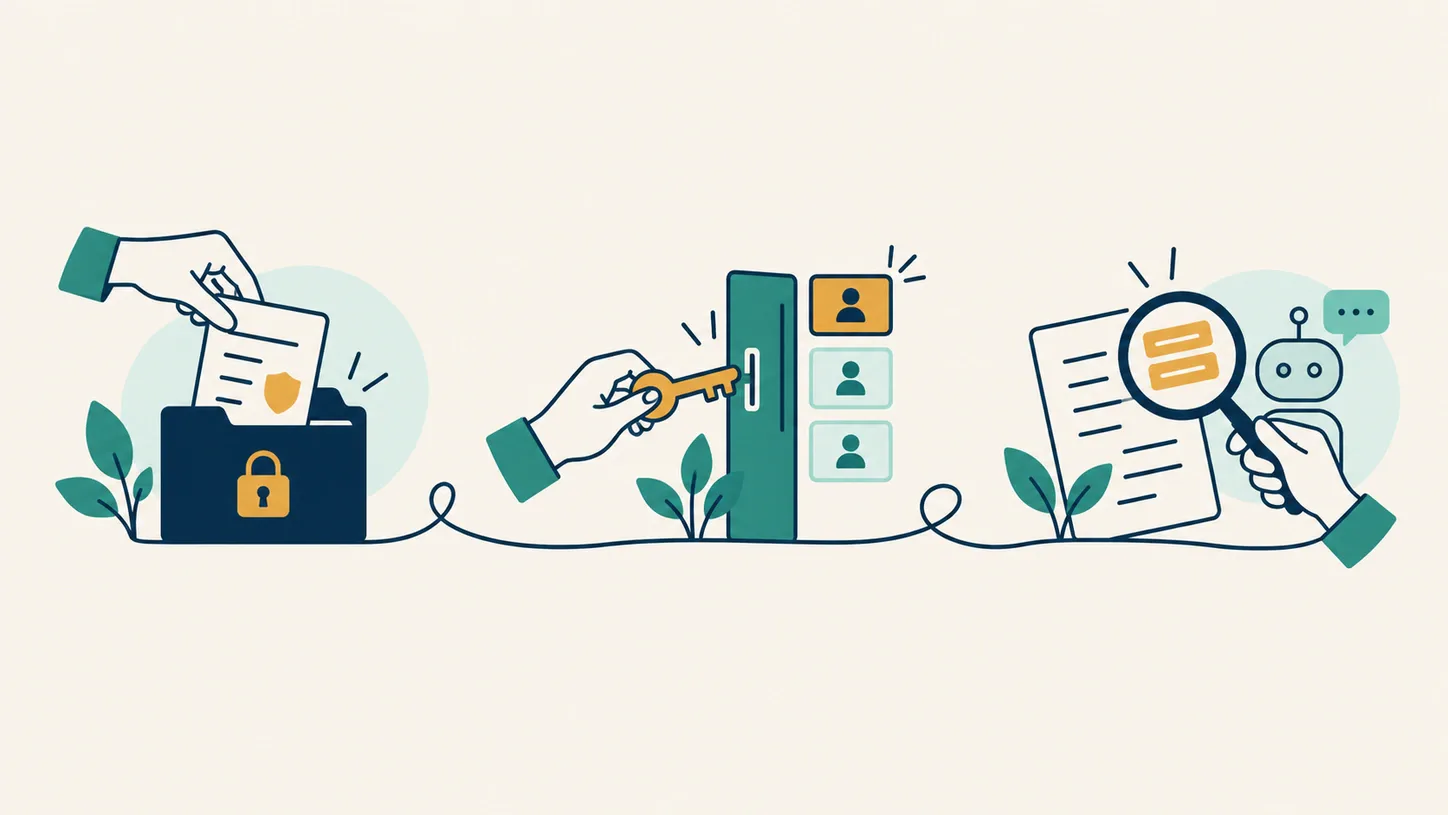
Responsible use requires three deliberate choices
- Protect dataChoose carefully what you share.
- Manage accessUse approved tools and follow the agreed rules.
- Check the answerVerify the content before using it.
Generative AI can help organize information, draft text, summarize material, and explore different approaches to a task. A useful answer is not automatically accurate or safe.
Employees need simple rules, sound judgment, and tools the company has assessed.
Use only approved tools
AI services handle data differently, including storage, access, use for training, processing location, and administrative controls.
Your company should clearly define which tools may be used for which tasks. A personal subscription or free online tool may not be suitable for company information.
Do not share information without authorization
Do not enter confidential business information, personal data, customer material, credentials, or protected content into an AI tool unless your company has explicitly approved both the tool and that use.
When a task can use anonymized, synthetic, or less sensitive information, that is often a better starting point.
Treat the answer as a draft
A generative model can sound convincing and still be wrong. It may miss qualifications, invent details, or reproduce bias in its source material.
The employee using the result must be able to check facts, sources, calculations, and professional judgments. The greater the potential consequences, the stronger the review needs to be.
Be clear about the purpose
Good prompting involves more than long instructions. Describe the task, relevant context, desired format, constraints, and the quality criteria for assessing the answer.
Ask the model to flag uncertainty, missing information, and assumptions. This does not make the answer correct, but it can make review easier.
Keep people accountable
The AI tool does not own the decision. This also applies when its output supports recruiting, customer communication, advice, security, finance, or other work that affects people and the business.
Your company should define when AI may assist, when a person must approve, and when generative AI must not be used.
Make the rules practical
An extensive policy is of little use if employees cannot apply it to everyday work. Combine concise shared rules with examples from actual roles and workflows.
Update the rules as tools, uses, and requirements change. Obtain appropriate legal, security, and data-protection assessments when the use case calls for them.
From insight to testing
See how responsibilities and access rights can fit into a practical operating model. Explore the decision framework. These figures are illustrative hypotheses to test in your own workflow.
Make safe use a shared practice
See AI culture in practice through direction, employee involvement, and role-based learning. Read about the inclusive hypothesis phase and AI training on the job.