
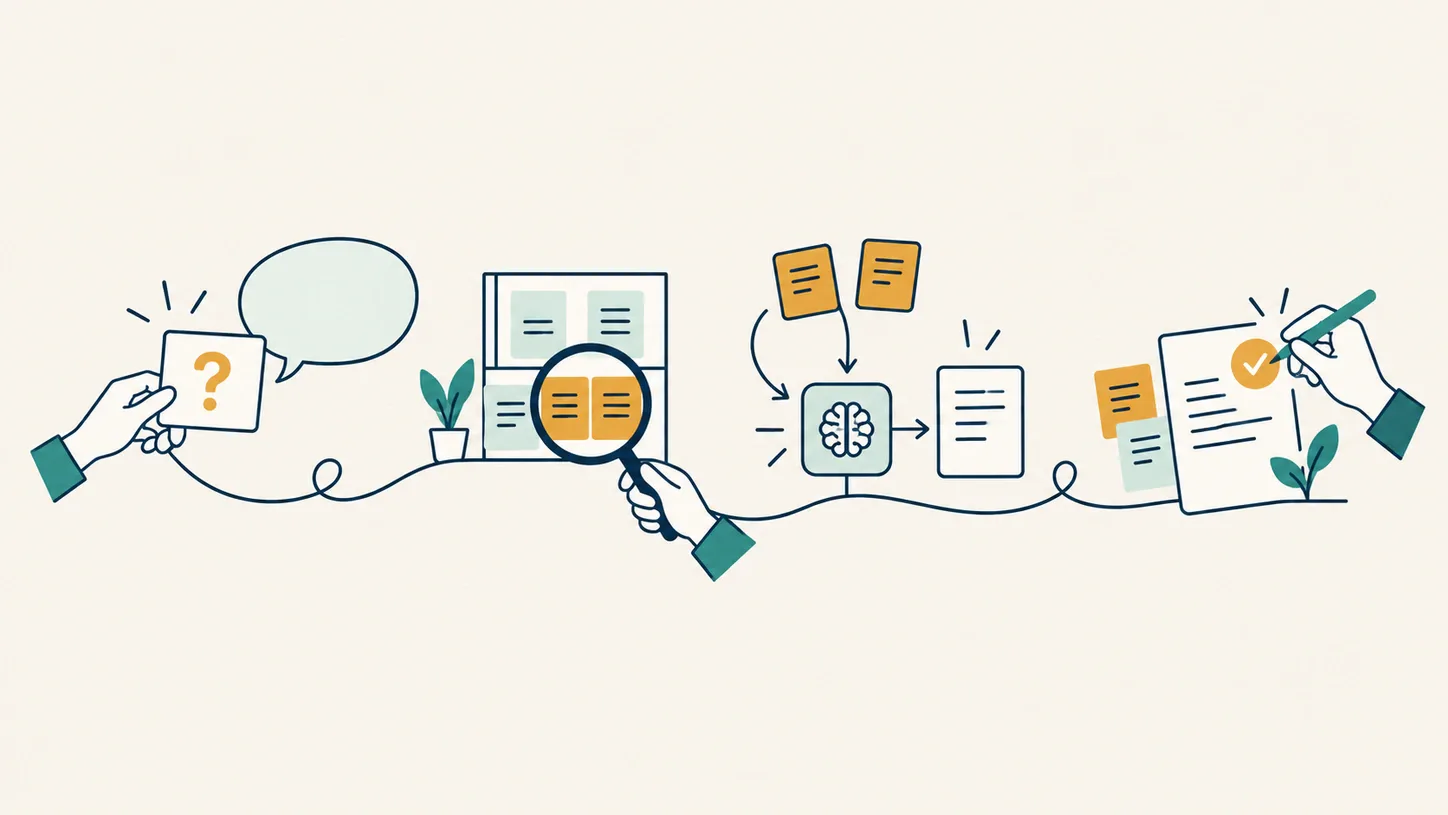
From question to an answer with sources
- QuestionWhat needs answering?
- Relevant sourcesSelected information is retrieved.
- AI draftSources inform the answer.
- VerificationCheck the answer against its sources.
RAG stands for Retrieval-Augmented Generation: generating an answer with the help of retrieved information.
The solution first searches selected sources for relevant passages, then gives that material to the model as context for its answer. This supplements what the model learned during training.
A simple example
Imagine an employee asking, “How do we handle this type of customer complaint?”
A general-purpose AI model can offer a general answer. A RAG solution can first find relevant sections in the company's approved procedures, guides, and product information, then base an answer on them.
This can make the answer more relevant to the business and allow the system to show which sources it used.
When can RAG help?
RAG can be useful when:
- employees spend substantial time searching across many documents
- relevant information changes more often than the base model is updated
- answers need to draw on the company's approved sources
- users need to see or verify the supporting evidence
- access to different parts of the content must be controlled
RAG still depends on content quality
Outdated, conflicting, or poorly structured documents can provide a weak foundation. If retrieval finds the wrong passages, the model may still produce a convincing but irrelevant answer.
Evaluate retrieval, source quality, the generated answer, and how the user is expected to act on it.
Four questions before a pilot
Are the sources suitable? Is the content accurate, current, assigned to an owner, and available in a usable format?
Is the user allowed to see the material? Access rules must follow the sources. Effective search must not bypass the business's permissions.
How will answers be evaluated? Define specific questions and expected quality criteria. Test normal situations, edge cases, and questions the solution should not answer.
Who owns operations? Someone must maintain sources, monitor quality, handle failures, and decide when the solution needs to change.
Use RAG to solve a specific information problem
Assess whether employees or customers have a concrete information problem that RAG can solve more effectively and responsibly than the available alternatives.
A focused pilot can show whether retrieval, answers, user experience, and operational needs work together in practice.
In our recruiting case study with internal RAG chat you can see an example of defined sources, user permissions, and test criteria before a wider rollout.